NOVINZIO

Artificial intelligence

AI that a public agency can stand behind.

We build AI into government work the way government needs it: every decision traceable, a named person accountable, and no answer passed along just because a machine produced it.

This site is designed to meet WCAG 2.1 Level AA, the level the DOJ's ADA Title II rule sets for state and local governments. Read our accessibility statement

What AI development means to us

Most of a good AI system isn't AI. In the systems we build, a language model does a few narrow jobs that need judgment, such as describing a picture or reading a scanned form. Everything else is ordinary software that gives the same result every time: the checks, the rules, the record of who approved what.

The real work of AI development is deciding where judgment belongs. Some decisions can be made by a model and confirmed by a person. Some must be made by a person. Some should never vary at all, and belong in code. Getting that division right is what separates a demo from a system an agency can rely on.

Where we use AI today

In internal testing · LA City Planning

ADA Remediation Pipeline

Proposes picture descriptions and form field names for a person to approve, and uses Azure Document Intelligence to read scans, tables and unreadable text. Each file is checked against PDF/UA and WCAG 2.1 Level A; files that don't pass are held.
In daily production · City of Los Angeles

KwikComply intelligent scan capture

Reads broker-submitted insurance certificates (ACORD 25) with Azure Document Intelligence and validates them against City requirements.

Read the KwikComply case study

AI proposes. Rules build. A person decides.

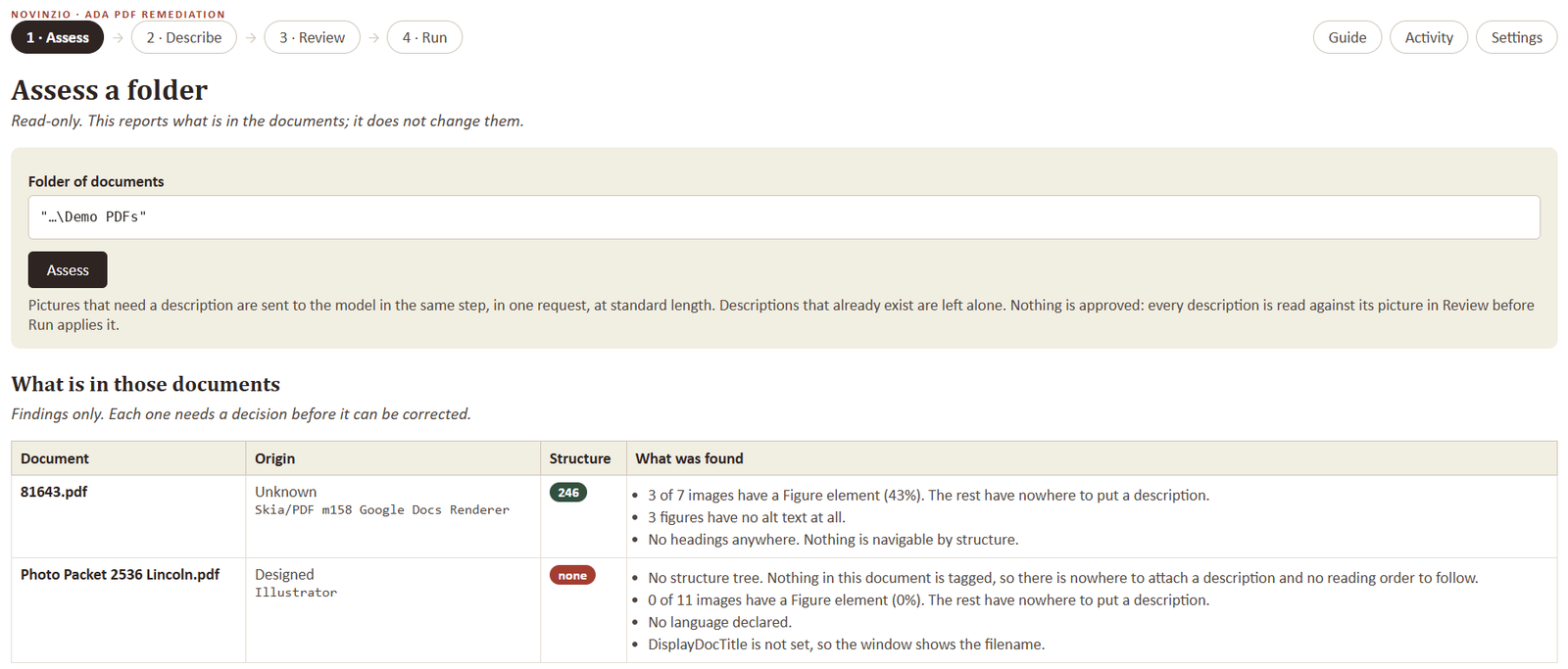
How the ADA Remediation Pipeline we built for LA City Planning divides the work. Nothing reaches a document without a named person's signature. Point to or select a step to see its screen.

Assess screen: a read-only report on two sample PDFs. One has a structure tree but three pictures with no alt text and no headings; the other has no structure tree, no declared language and no title.

Assess: a read-only report of what each document needs.

Screens from the ADA Remediation Pipeline in internal testing at LA City Planning. File paths shortened. Select a screen to open it full size in a new tab.

See the pipeline work through real PDFs, step by step.

Schedule a demo

Our governing principles

These are the rules we build AI around. Where it helps, we show how each one works in our ADA PDF remediation.

  1. 1

    AI proposes. A person decides.

    A model can suggest an answer, but a named person approves, edits or rejects it before it affects a record or a decision. In our ADA PDF remediation, AI never writes to a document on its own.

  2. 2

    Rules do the building.

    Once a decision is approved, fixed code applies it the same way every time, so results can be tested and repeated.

  3. 3

    Check every result independently.

    Finished work is verified by a separate, standards-based check, not by the AI that produced it. For PDFs, that check is veraPDF.

  4. 4

    Never pass a failure quietly.

    When something doesn't meet the standard, it is held with a plain-language reason, so the agency always knows what passed and what didn't.

  5. 5

    Keep a record.

    Who approved what, when and why, for every item. An auditor or a resident should be able to follow it.

  6. 6

    Keep the data where it belongs.

    Our AI runs in Microsoft Azure, with processing kept in the United States.

  7. 7

    Make each decision once.

    When the same issue comes up again, an approved decision is reused rather than made again, and the record shows who made it. In our ADA PDF remediation, a fix approved once carries to every copy of the same picture, in this document and later ones.

Using AI responsibly in government

Public agencies carry obligations a private company doesn't: due process, public records, accessibility, equal treatment. AI has to fit inside those obligations, not around them.

Accountability stays with people

A model is never the decision-maker of record.

Transparency is built in

Agencies can explain how any result was produced, in plain words.

Honesty about limits

No AI tool gets everything right the first time. We design for the cases it misses.

Service for everyone

We use AI to make government more accessible, starting with documents screen-reader users can actually read.

Insights that shape our work

The thinking behind the rules: what separates AI an agency can rely on from AI that only looks finished.

A passing check isn't a right answer.

An automated checker can confirm that a picture has a description, but not that the description is useful. A file name like "image1.jpg" passes the check. Human review belongs exactly where machines can't judge meaning.

How something was made predicts how it breaks.

Documents created by the same program fail in the same ways. Grouping work by its origin turns many one-off fixes into a few approved decisions.

Plan for what doesn't pass.

Hard cases are held, diagnosed with the agency's staff, fixed in a tested release, and covered for good from then on.

The best fix is often upstream.

Export instead of "Print to PDF." Name form fields when the form is designed. Fix the template before it goes out for signing.

Work alongside the tools people trust.

The pipeline doesn't replace Adobe Acrobat. It handles the volume, and agency staff check results in Acrobat, as they always have.

Start with one hard example.

The fastest way to evaluate AI is on the document your team struggles with most.

Planning your agency's first production AI system?

Schedule a demoTalk to us about AI for your agency